Tuesday, September 4, 2012

You’re Invited to Change These Lives!

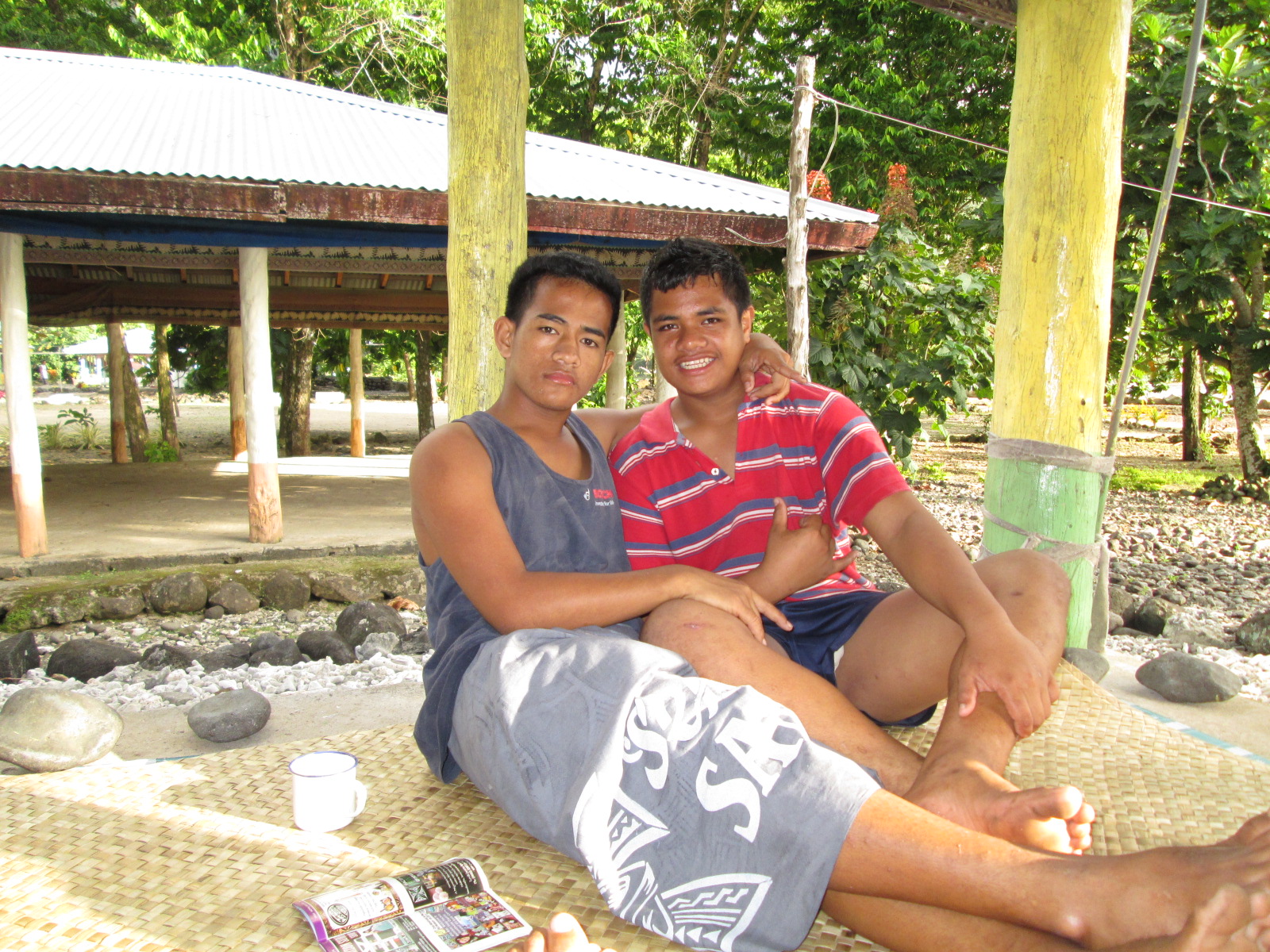
Saulo, Neueli and Milo with me earlier this year.
Thank you for reading! This is a very special blog, unlike any I’ve written in the past. This is because it has the potential to change the lives of three Samoan boys, and you can be a part of this change.

Many of you are aware that I first arrived in Samoa back in 2009 as a Peace Corps Volunteer, where I taught English at a rural primary school until last December. I then returned to Samoa this year to volunteer for the Catholic Church, assisting with their Catholic youth bands.

During my two years as a Peace Corps Volunteer, I was fortunate to see each of my students develop and mature to become better students and better kids. Despite not having enough desks, chairs, or even a set of text books, they always tried hard; they came to school with smiles on their faces and eager to learn. When we first met, their views of the world were very narrow, their understanding about other places not as great. They had grown up on a small island in the middle of the Pacific Ocean, never having traveled. However, through our conversations I tried to spark their interests in this world, to ask questions, to dream for something bigger!

This past June, I felt God calling me to help them in a new way, to help them realize some of their new dreams! I was sitting in church when I started thinking about taking the three of them back to the United States for a one month visit when I return to there this December. In the days that followed, I worked on forming a program which would inspire, motivate and empower them. I know that their traveling to the United States would be a once in a lifetime opportunity for them, and one that could help shape their futures.

However, from the beginning I have told God that if this is meant to be, He will have to help lead us through it. I am unable to provide for such a trip financially, yet I have faith that the money will come if it is meant to be.

Therefore, I am asking each of you to take a few minutes to read over my full project proposal, the Samoa Youth Empowerment Initiative, which I have copied below and consider making a donation to help make this trip possible for my three former students. If you are only able to give a little, please do so and know that it will make a difference. For those who can give more, your generosity is just as meaningful. With the application for the U.S. visas quickly approaching in October, I am asking that you make your donations as soon as possible. The visas will have a much better chance of being approved if sufficient funds are secured prior to the application being filed.

I have set up an online Paypal account where you can make a donation using your debit or credit card. When you send the gift, there is a space for you to type a message. I ask that in that space you provide me with your name and mailing address so that the boys can send you a card of thanks for your helping them on this project. It is your generosity which can make this program a reality for these three Samoans!

If for some unfortunate reason, the visas are denied, I want you to know that the money will instead be invested in the boys’ village on meaningful and sustainable projects, either in the school or on youth empowerment projects which I would help oversee.

Again, I thank you for your time, for your gifts and for your support! Please visit the blog in the weeks ahead to learn about our progress on this program.

HOW TO USE PAYPAL:
1. Go to paypal.com
2. Select the tab titled, “personal” and click on “send payment online.”
3. In the box titled, “To” put my email, samoayouth@hotmail.com
In the box titled “from,” put your email. Select an amount you wish to donate and a currency. The bubble titled “Goods” should be selected, leave that and click the yellow box, “continue.”
4. You will then be prompted to create a paypal account. (Don’t worry, it’s not hard). Fill in your information, creating a password and entering your credit card or debit card information. Check the box at the bottom that you agree to the terms of use and then click the yellow bar that says “Agree and Create Account.”
5. You will then get a confirmation page that your paypal account has been created! Review the amount you are donating and then scroll down to the second portion of the page, under the blue bar where it says “Email to Recipient.” In the box titled, “message” type your name and address so that the boys can send you a thank you note! Under the message box click the yellow box titled, “send money.”
6. You will then get a page that should say “money has been sent.” Click on the yellow box titled, “Go to my Account” and at the top of that page, click on “Log Out” to safely log out of your new paypal account.

That’s all there is to it, it should take less than 5 minutes! If you have questions, email me and I can help you through it. Thanks again!

---------------------------------------------------------------------------------
Project Proposal
Project Title: Samoan Youth Empowerment Initiative (SYEI)
Project Coordinator & Contact Info:
• Kyle Kincaid
• Email: samoayouth@hotmail.com
Blog: kincaidsamoa.blogspot.com

Total Amount Requested: $7,265.62 USD
Project Timeline: December 15, 2012 – January 12, 2013

Project Summary:
As a former Peace Corps Volunteer in Samoa, having taught English at a rural primary school, I am now making an effort to promote a youth empowerment initiative for underprivileged, rural, Samoans. I intend to have three of my former male students, ages 14 to 15, travel back to the United States this December. There, they will live with my family and me in Michigan for one month, while taking part in several cross-cultural and volunteer activities which otherwise would not be available to them in Samoa.

In addition to the Samoan students learning about American culture and the importance of volunteerism, the Americans they meet and associate with will learn about Samoan culture and customs, thus allowing both parties to develop a more global perspective.

The Samoan students will be very active: visiting a local elementary school to make presentations to their American counterparts, volunteering their time at a community center for students with physical and mental disabilities, and assisting local churches with volunteer programs within the community. I am also hoping for them to have the opportunity to meet with local business people and trained professionals such as doctors and nurses, in an effort to broaden their outlook on possible career opportunities for their futures. Students will also participate in a culture night where community members will be invited and both Samoan an American culture will be on display. The evening will include dances, foods, games and presentations including pictures and videos.

Project Rationale:

Samoa’s national languages are Samoan and English, with most of the National Exams in the upper grade levels being administered solely in English. The government in recent years has placed great emphasis on students becoming proficient in English, as they recognize it as the global language which will help its citizens to better compete for jobs in this competitive global economy.

My three former students, live in a rural village, and attend public schools that lack proper resources, such as text books, technology and even sufficient desks and chairs. They have faced several educational challenges which seem to compete against their own natural, God given talents. Nation-wide test results also show that students living in rural villages perform at a much lower level academically than their counterparts living in or near the capital city.

Each of these three young men have made significant progress in the past couple of years: two of them earning awards for most improved student of the year within their class, and the other receiving the highest test scores at his school on the National Examination. This cross cultural, youth empowerment opportunity will allow them to build on those talents they already have begun to develop.

By exposing them to a new culture, introducing them to new career possibilities and teaching them the importance of volunteerism, they will return to Samoa with a more focused outlook for their futures and thus allow them to become better leaders within their families, villages, churches, and ultimately their country.

Project Goals and Objectives:

The Goal of the project is for three Samoan youth to take part in cross-cultural experiences and volunteer initiatives in the United States. As a result, this will help them to broaden their English skills, develop sensitivities towards another culture, inspire them towards higher academic learning, and lead them to better professions within the workplace.

The Objectives are:

1. 3 Samoan students will return to Samoa in January of 2013 from the United States and show an increased awareness to those of another culture, by conducting a 1 day seminar and presentation for the youth of their village, to be assisted in preparation by their pastors.
2. 3 Samoan students and the youth participants of their seminar, will together, with assistance from their pastors, develop, design and conduct a 1 day community outreach activity which will promote community engagement and civic responsibility.
3. 3 Samoan students will demonstrate higher English proficiencies on an oral exam to be given by a trained language professional from the U.S. Peace Corps office in Samoa, both prior to and after the students’ program in the United States.

Project Beneficiaries:

There are 4 primary beneficiaries of the project, as follows:
• The 3 rural Samoan students who will travel to the United States for the cross-cultural and volunteer opportunities, thus allowing them to build a series of transferable skills which they will be able to utilize throughout the rest of their education as well as throughout their future careers.
• The youth participants from the village, who will engage in the community project and seminar, following the students’ program in the United States.
• The pastors who will assist in leading the youth seminar and outreach village program, thus making them a sustainable partner for more youth empowerment initiatives within their community.
• The Americans who will learn from the Samoans about a new culture and develop new ways of thinking and acting to be better members of their local and global communities.

Project Budget:

At present, funds need to be raised to support the financial obligations of the project. Following, is a spreadsheet which highlights the expenses we will need to provide for the program.

Expense Total (USD)
U.S. Visas $480.00
Airfare $4,907.62
Traveling money (en route) $120.00
Transportation (gasoline) $300.00
Toll Road Fees $50.00
Health Insurance $108.00
Food $700
Warm clothes & shoes $300.00
Museums/extra- curricular events $300.00
Total Amount: $7,265.62

Project Timeline:


September 2012
• 3: Begin distributing project proposal for Samoan Youth Empowerment Initiative.
• 6-30: Prepare U.S. Visa applications and meet with students and their parents to secure proper paperwork and prepare for visa interviews.
October 2012
• 1: Await announcement of visa interview date for this month.
• 8-30: Wait on word from the U.S. Embassy about visas and then purchase airplane tickets once visas are secured. Also organize with partners of the program in the United States to prepare for students’ arrival in December.
November 2012
• 1-15: Meet with pastors in students’ village to train them in possible community projects they will conduct with the students following their program in the United States.
• 1-30: Continue to work with program partners in the United States to develop details of the program.
• 30: Students take first oral English exam from language teacher.
December 2012
• 15: Depart with students from Samoa and travel to Constantine, Michigan.
• 15-31: Samoa Youth Empowerment Initiative is in progress.
January 2013
• 1-9: Samoa Youth Empowerment Initiative in progress.
• 10: Students depart from Chicago, Illinois for Samoa.
• 20: Students take for the second time, the oral English exam.
February 2013
• Students partner with their local pastors in Samoa to prepare for presentation of their experiences in the States to deliver to the youth of their community. Together with that same group and the pastors, they implement a youth outreach program for the community addressing a local community need or issue.


Neueli, Saulo and Milo climbing the mountain near their house in 2011.

INTERESTED IN HOW I MET MILO, SAULO & NEUELI?

Read the blog below if you'd like to know more about how I know each of these young men. The blog was originally posted on February 16, 2012.

The Brothers

During my two years as a Peace Corps Volunteer, I gained three friends who I now call brothers. Although I gained friendships with many throughout my village, these three individuals each played a unique role in helping me through my toughest days, and then supporting me through my best. Looking back now, I see how each of us grew to become stronger people during those days we faced together, both the good and the bad. I invite you to read about how we became friends and what we learned from each other.


Milo and I met on one of my hardest days as a Peace Corps Volunteer—my first day. I had just been picked up in a van from the capital, and ridden out to my village to start my new life. When the van came to a stop on the road near my house, there he was, eager to help with my heavy bags and looking at me with much curiosity. From that first day, when I needed him the most, when I needed a friend like I had never needed one before, he was there.

From that day on, there were very few that passed where Milo and I didn’t see each other, or talk to one another. He lived right next to my house, and I quickly became like an adopted son to his entire family. Milo and I spent so many days together, that on the rare occasions we didn’t see each other, I felt like something was missing.

As the months went by, our friendship continued to grow. At school he was my student, and during my first year, he was one of the weakest students from his grade level. He lacked confidence, and relied heavily on his mom to complete basic homework assignments. But as we spent more time together, both inside and outside of school, I began to challenge him more, and he began to succeed, recognizing his own abilities and strengths. By the time my second year arrived, he was one of the strongest students in his grade level, answering questions with confidence and a smile, the same questions which kids use to laugh at him for not knowing the answer to, just the year before.

Samoans are very competitive, and this certainly holds true at school. Teachers often post publicly, the class test results and end-of- the-term rankings of students. Therefore, I didn’t feel at all out of place when I posed the question to Milo about if he would like to gain the number one ranking in his grade level and be at the top of his class. He certainly said yes, but I told him he was going to have to work hard if he wanted to get it.

Milo did work hard, and on the last day of school, he had earned himself that 1st place ranking over his fellow classmates. I’m so thankful he learned how to dream for something, and then follow through to the end to accomplish that goal. I think he also served as a great example to other kids who took notice at how he had grown, and perhaps they are asking themselves now if they have what it takes to do the same.


I remember the first time I met Saulo. It was very early on in my arrival to the village, perhaps my second or third day. I was walking down the street with Milo, and beside me was this skinny little kid talking a hundred miles an hour and then laughing at everything he said. I remember feeling a bit annoyed at the time, not understanding what he was saying, and thinking he might be talking about me. He probably was!

As a student of mine, I quickly began to realize he was one gifted person. His English was one of the highest of any of the kids at school, and his energy day after day was infectious. This kid didn’t slow down, but just kept on charging ahead. He often enjoyed reading a book at school, titled, “Keep on Trying.” In this book, a boy had to keep learning how to do new things, such as riding a bike, or playing a game and thus was forced to “keep on trying.” I’ll never forget the time when Saulo and I were walking through the village one evening and he told me he was going to “keep on trying,” to do his best at school, and learn English. It was moments like that which made me smile.

Last June, when I decided I wanted to build on my Samoan language skills more, it was Saulo whom I turned to for help to act as my tutor! Yes, there were some adults I could have asked instead, but I knew that in asking Saulo, I would be placing a trust and responsibility on him that many hadn’t challenged him with before. It ended up being a win/win situation for both of us: my Samoan, and his English.

Many afternoons, it became routine to walk over to Saulo’s house to watch him prepare his family’s evening meal. I could just sit there for 15 or 20 minutes and watch him peel the green bananas, or cut up the chicken and toss it in the boiling water, cooking over a fire he had just made minutes before. I think it was a way of me simplifying my day, and appreciating some of the hard work that goes into preparing a meal for a Samoan family.


My first memory of Neueli was during one of my classes at school. It was a time when I was still very much homesick, and doubting myself as a Peace Corps Volunteer. He helped lift my spirits that particular day, just by his saying thank you to me, and from that point on, I began to look at my time in Samoa in a completely different light.

I also can remember the days when I use to pronounce his name wrong. Just by your reading it, I’m sure you can tell it is challenging, although it now seems like second nature. However, I had been saying it wrong for the first couple weeks of school, until one day, he and Saulo came up to me one morning and said that they were staying inside at recess to teach me the proper pronunciation. They did, in fact, take the time to come in, and I think they drilled me for 10 minutes before leaving. From that point on, I had it down!

Neueli was always smiles. He came in to the room each morning with a cheer that other students just couldn’t quite match; he must be a morning person! Neueli, like Milo, had struggles with his school work early on, not being able to read basic sentences. His favorite book was “Little Car,” and over time he began to master not only that book, but several others I would place before him. During our second year together, it was so rewarding to be reading with a student from a younger year, and have Neueli come strolling into the room over to the side of my desk where he would start helping the students on words they didn’t know. He always got this excited look on his face, after realizing that he once was the struggling reader, but over time had learned to achieve and move to a higher level!

These kids, like most Samoans, have grown up in a very large family with many other siblings. Although Samoan parents love their children, it is still hard, and not completely a part of their culture, to spend individual time with the children as they are growing up. However, when Milo, Saulo or Neueli visited my house, I think they were able to find some of that personal attention which they didn’t always receive at home. In my house, I treated them as equals, as kids with ideas, challenges and successes. Perhaps at my house, more than in any other place, they were able to be kids—they weren’t required to do a bunch of chores, look after a younger sibling, or run an errand to the local store. They could just be themselves.

As not only their friend, but their teacher, I was left in a difficult position at school when I had to discipline them for one reason or another. I struggled until the very end to get them to understand that when we were at school I was their teacher and as a result, couldn’t goof around like we would after school. Although this was a challenge, it was one I was willing to take on, because our friendship meant so much to each of us.

We have so many memories together, both happy and sad. On the afternoon that the Peace Corps delivered word to me that my grandma had passed away, it was the three of them that came to my house to be with me, give me a hug, and then ask if there was anything they could do. We also shared so many happy times together: climbing the mountain near my house, going to the river or ocean for a swim, and dancing to music in my house.

There were also countless cooking classes, in which I taught them how to make “American foods” such as chocolate pudding, tapioca, popcorn or oatmeal. They were never shy about asking for a ripe banana or a cold glass of water from my fridge. They even were able to eat M&Ms and Peeps for the first time in their lives. When I cooked oatmeal before my Peace Corps experience, it was just oatmeal, but now when I cook it, it’s a memory of my time with Milo, Saulo and Neueli.

When I left Samoa, I left knowing that not only had I helped change the lives of these kids, but that they had certainly changed mine. I know they have bright futures ahead of them; I saw each overcome their own challenges and become better people in the process. I hope I never forget the things they taught me, like how to face new and unfamiliar obstacles, how to be accepting of new ideas, people and cultures, and most of all, how to love a dear friend.

Tuesday, August 28, 2012

Money Transfer: No Fees Accrued


I think it’s fair to say that Americans are raised to be independent. We go to school to earn grades for ourselves. We attend universities to get jobs for ourselves. When we get jobs, we save money to buy houses for ourselves. Being independent certainly has its positives, but it also can cause a person to think too narrowly, and rely too much on themselves.

If you ran out of eggs or milk, would you go to your neighbor’shouse and ask to have some of theirs or would you drive to the store? If your car broke down, would you ask someone for a lift, or would you wait for OnStar to arrange one for you? If your power went out for several days yet your neighbor’s didn’t, would you ask to run an extension cord from their house to yours, or would you wait in the dark for yours to be turned back on?

These are all contrasting ways of approaching inconvenient situations. Americans would normally lean towards solving the problem through a more passive approach: driving to the store, waiting for OnStar to arrive, or for the electric company to show up. None of these are negative ways of approaching the situation, it’s a cultural reason that they are approached in such a way, yet what would happen if you did place trust in your neighbor, if you took a chance to reach out to someone for help, rather than being passive?

I did just that—placed trust in my “neighbor,” in fact, a complete stranger! Last Friday I made a game. I decided I was going to send 10 tala (a little less than $5U.S. Dollars) to Nancy, a Peace Corps Volunteer on the other main island of Savaii. Nancy happens to be a bus ride, a boat ride and then another bus ride away from the market in Apia. I wanted to know what others were willing to do for me. Were they willing to hand off an envelope to a women they didn’t even know? Would they be trustworthy, or would they snoop inside the envelope and take the money, which happens to be a fair amount here in Samoa.

My first task was addressing the envelope. I knew I wanted to write a message on the front of the envelope in Samoan. Although I wouldn’t say my Samoan is bad, it’s hardly blockbuster material, and in a situation like this, I was going for accuracy, so I asked one of my students to address the envelope. I had her write, “Fa’amolemole pea mafia ona e ona e kilivainaatulouteutusi lea iaPisikoa Nancy i (village name) i Savai’i. Fa’afetai lava moloufesoasoanimaiiafa’amanuia le Atua. Soifua,” which reads, “Please deliver this envelope to Peace Corps Nancy in (village name) in Savai’i. Thank you very much. Thank you to God for your help. Good health to you. And with 98 percent of Samoans professing to be Christians, it never hurts to add a cross to such a document, so I drew one under my greeting.

With the envelope marked and a short note tucked inside for Nancy, I sealed the envelope with a piece of clear tape and headed for the market. As I walked towards the bus that would head to the wharf, I decided that as part of this challenge, I wasn’t able to speak any English, even if the person I handed it to did speak English. I also was looking for someone who looked reliable. Although I would have trusted a man as much as a women, I did decide to give it to a women. The way you dress in Samoa can also carry a lot of weight. A person in professional dress receives a certain amount of respect just for being dressed as such, so I started looking for women who were wearing a pulatasi (the formal dress women wear). I spotted one, sitting near the front of the bus.

I took the envelope to her and explained that I needed her to deliver it to Nancy, the Peace Corps Volunteer in Savai’i and she said she wasn’t going that direction, but immediately, the women sitting behind her (not wearing a pulatasi dress, but rather a t-shirt), said that she would pass it off to the correct bus after the boat arrived in Savai’i. She also said, “Trust me,” which seemed like a red flag to me, since I didn’t even suspect her of anything. But I let it be, and within less than 20 seconds, I had handed off the envelope: it was 1:00p.m.

One minute later the bus pulled away and I had texted Nancy that the envelope was en route. I didn’t think much about it after that, until evening came around and felt a certain sense of disappointment that I hadn’t heard from Nancy and I figured it was a lost or stolen envelope. I swore I wouldn’t be doing such a thing again just to prove a point.

But at 5:55p.m.the text came; it was from Nancy! “The eagle has landed!” were the first words on the screen! You should have heard me laugh! Within less than six hours, my envelope had traveled from one island to the other, by multiple modes of transportation, and get this, through five different people’s hands! Nancy had somehow tracked its history, telling me that the women I had handed it to had given it to a women from Nancy’s village on the bus in Savai’i. That women then gave it to Nancy’s host brother who she spotted on the boat. Nancy’s host brother was distracted by a rugby game that was showing on T.V., so he handed it off to his little sister and her friend who then went straight to Nancy’s house and started pounding on the door—so loud that she quit taking her shower to answer the door dripping wet!

Samoans have taught me a lot of valuable life lessons the past three years, but perhaps one of the most important is to trust in my neighbor. Trust that they will help me in times of need. Trust that they will go out of their way and make sacrifices in order to accommodate me. It’s an amazing human quality which many in this world today lack, but one which more of us should try to exemplify. What would you do for your neighbor? Would you be willing to do things that might be inconvenient, if it would mean making their life a little easier?

Besides this being a great story to tell, I hope it reminds us all of the things we can accomplish if we work together and the things we can do for others who perhaps need a helping hand!

Editor’s Note: A special thanks to Nancy from Group 83 for helping make this blog possible by serving as home base for the envelope, and for taking pictures on her end! Nancy keeps an awesome blog about her time here in Samoa as a PCV, so I encourage you all to visit it when you have some time (http://nancymagsig.blogspot.com/)


At the bus stop, getting ready to hand the envelope off to a complete stranger.


The envelope and its message to deliver it to Nancy.


Nancy with the envelope and money at 5:55p.m., less than 5 hours aftre I handed it off to a complete stranger on another island.


Nancy thought my choice of a Chinese envelope was the best part! It was by accident that I ended up with this, buying it on the way to the market.


Nancy's host brother was the third person in the line to receive the envelope, but he couldn't take it to the finish line because he was busy watching a rugby game.


Nancy's host sister and her cousin who delivered the envelope to Nancy at 5:55p.m. Good job to everyone along the way!!

Monday, August 20, 2012

The Blue Folder Anniversary

Riding on a bus in Savai'i last year.
Although it’s already August 21st in Samoa, in Michigan, where I was three years ago today, it’s still August 20th, and August 20, 2009 will be a day I remember for years to come. Perhaps the thing that stands out most from that day is the blue folder which held so may details of my future. It was a blue folder from Peace Corps, sent by Fed-Ex and opened by me shortly after 4p.m. that day. On the cover it read, “Peace Corps Invites You to Serve.”

I was sitting on the couch with my mom nearby. I remember holding it for a couple minutes before I worked up the courage to open the Velcro flap, but once I did, the first thing that caught my eye was the word “Samoa,” highlighted in yellow. I remember being surprised, because for several weeks before that day I knew I was going to the South Pacific region, and I had read over all the programs and based on what I knew from my recruiter, I thought I was headed to Vanuatu! But heck, Vanuatu, Samoa, where were either of them anyways?

Shortly after opening the folder, I headed for a map to pinpoint exactly where the next years of my life would unfold. Sure enough, it was in the South Pacific, a long ways from Michigan, and a long ways from anywhere!! I remember calling my sister, friends and other family. I even remember what I ate that night—sweet corn and tacos. It’s all vivid in my mind like yesterday.

Little did I know that day, that there were already people here in this country who would become like family to me, like brothers, best friends. I had yet to meet anyone of them, but on that day, our paths were charted towards each other, and the word Samoa became a part of my life.

It’s amazing what has happened in the three years since that day! I could never have guessed back then that I would go and have an amazing Peace Corps service, return home and then come back to Samoa for an additional eight months! That’s where this all finds me today, reflecting on the past and all that I’ve had the opportunity to do, all those I’ve had the opportunity to be with and learn from.


Thursday, August 16, 2012

I Get Locked Out, But I Get In Again

No keys are needed to have access to a view like this.

In the past year I’ve had two unfortunate experiences here in Samoa with getting locked out, and getting locked in. Let’s start with the locked out story, which happened just last week.

It was Wednesday, and I had just gotten home around 6p.m. after a long day and just wanted to eat and go to bed. I decided to go across the road to the store to get some bread. When I got over there a pack of dogs came after me and I fended them off by using my key chain lanyard. When I did that, I was unaware that part of the lanyard had come off and it happened to be the part that held the keys. By the time I discovered that, the dogs had already picked up the keys and ran away with them somewhere on the surrounding property. I spent 20 minutes looking around for them, as well as my neighbors who came out to help. Finally dark set in and I had to give up.

Luckily, I have two doors to the house, so I was able to get the spare set of keys from a neighbor. However, the door that I had lost the keys to is my main access door and I didn’t have any spare keys for that door, so the next day I was forced to go and buy a whole new doorknob!

The really disappointing part of the whole story is that the store didn’t have any bread that night, so my trip ended up costing me 35.00 tala, the price of the new doorknob.

The next story is a locked in story! I was able to find out what it feels like to be on house arrest. Last year when I was still living in my old house, I was getting ready for school on a cool, windy and rainy morning. I went into the bathroom to shave and while I was in there, the wind blew my bathroom door shut. Although I loved my house dearly, it had a few drawbacks, like there not being a handle on the bathroom door, although it did have a lock and latch. After the door blew shut with a huge slam, my heart sank for a minute. I thought that I had heard the lock catch!

Sure enough, I was locked in. Not only was I in a locked bathroom, I was in a locked house and since students always come to school late on rainy mornings, which it was. As I’ve said in the past, when it rains in Samoa it rains hard! So despite the fact that I had my neighbors living not 25 yards away from me, no matter how hard I yelled, they couldn’t hear me with the rain pounding down on the metal roofs. I ended up having to wait around in there for 45 minutes before anyone came along for me to yell at.

One of my year 8 students, Luisa was the first one I saw, and I yelled at her to come over to the bathroom window. By that time I had devised a plan! As I said, my house had a few drawbacks, although some turned out to work in my favor. There was a small crack near the water pipe for the toilet that went through the cement wall from the outside. I told Luisa to go to Milo’s house next door and get a knife to pass through the crack so that I could unjam the lock on the door. By the time she came back there were a handful of students outside my house laughing at the situation, and I had a pretty good laugh too. The idea worked and I was set free with little psychological damage.

I guess all this locking in and locking out got me thinking about the song by Chumbawamba, “I get knocked down, but I get up again, no you’re never gonna keep me down.” My new lyrics to that song are, 1st verse: “I get locked out, but I get in again, no you’re never gonna keep me out.” 2nd verse: “I get locked in, but I get out again, no you’re never gonna keep me in.”

Thursday, August 9, 2012

Friday In Apia

Last Friday's Sunrise
Last Friday I had my camera with me in town and decided to capture some of the sights around the capital city of Apia. Enjoy the pictures!


A boy walks the sea wall shielding himself from the sun with an ie lava lava.


The clocktower.


The old market has been torn down and now they are getting ready to build a new one.


A Happy Father's Day sign in front of Chan Mow, since Father's Day is celebrated in August here--this weekend in fact! Happy Father's Day!


Mother and son wait patiently at the light.


Some matai (chiefs)sitting and talking near the town center.


A van tailgating (he was laughing about it too)!


Some koko Samoa, whcih I bought!! YUM!


The newspaper stand.


I think it's universal; kids get tired waiting for mommy at the grocery store.


Ice cream on a hot day!


Guys playing their guitars.


A shipping freighter in the harbor.


The delicious cake at Keli's House of Goodies.


Not legal in Michigan!


Free in-flight magazines available at Air New Zealand's office! A good read.


Monday, August 6, 2012

Uafato: The Last Frontier

I’ve described my former Peace Corps village for the past two years as one of the most remote areas in Samoa. Although that still holds mostly true, I have discovered a village which tops the list and most certainly holds the title of the “Last Frontier.”

It’s a village I had always know about, and had heard was a long ways away. Looking at it on Google Earth made it look impressive and almost served as a dare to conquer the journey. After nearly three years of living in Samoa, this past weekend, I finally made the journey there by foot from my former village. But I wasn’t alone; I’ve learned to take along helpers to make these excursions more bearable.

As the crow flies, Uafato is only about 4 miles from my former village; however, with all the twists and turns of the ocean’s shoreline which we followed, it was more like a 16 mile trek! Saulo, Milo, Neueli, Satupa’i and I left Saturday morning around 8a.m. under some nuisance rain clouds. However, they soon parted and gave way to the full force of the sun which becomes taxing after a while.

For the trip the boys had brought along a small knife for opening coconuts, and I had bought some loaves of bread, peanuts and cookies to snack on along the way, since I knew we weren’t going to be bumping into any McDonald’s. Neueli decided on wearing long pants to protect his legs from all the thorny weeds, although the other boys and I decided to deal with the cuts to avoid the uncomfortable sweating and warmth caused by the long pants.

We had been traveling for about an hour when Saulo pointed out a tree along the edge of the bay. I looked over and there was my name, carved in capital letters into the trunk. Saulo said that this past February he had been over there in the bay and carved my name into the tree. Seeing that tree, I realized that he was thinking about me, as much as I had been thinking about him and the others I was missing earlier this year after I had left Samoa. Although I had left and was living on the other side of the world, Saulo had taken the time to carve my name into a tree in one of the most far-away places one can travel to. You can believe that I won’t forget that tree is there when I leave later this year. I told him I would be carving his name into a tree when I get back to Michigan!

We continued along, walking through a handful of small villages as we circled along the bay. We stopped at several small road-side stores called fale’oloas, trying to get our hands on some Coke, Sprite, or anything to quench the thirst we had. The boys were able to drink water from the small streams, but I wasn’t going to risk drinking water that hadn’t been boiled, so I held out and we finally drank some coconuts later in the trip.

As we left the bay and headed out towards another rocky point, the sealed road soon ended and we were walking on uneven rocks and dirt that increased in steepness, and then would drop low for a while, before climbing. The scenery and bends in the road looked so similar to the boys’ village, and often times they or I would comment on how it was almost an exact replica of a portion of our road.

Only Saulo had traveled to Uafato before, since his grandma and uncle live there. For Milo, Neueli, Satupa’i and I, it was our first trip. As we walked along and the boys complained about the heat and steepness of the road, they kept asking Saulo how much further. We finally reached a high spot in the road that had a sharp bend in it and when the boys made the turn, there was Uafato. I wish I had had the video camera rolling then to record the expressions they had when they made the turn, but it was a synchronized “aaaaawwwwww.” I was impressed that even Samoan teenagers would be captivated by scenery you think they would have grown accustomed to seeing, but luckily they still hold some fascination for the beauty of this country.

The village was situated by itself in a small bay with high mountains flanking every side covered in lush green tropical foliage and amongst it all, one of the highest waterfalls I’ve ever seen, stretching from the top of one of the mountain peaks down to the land below. Our rocky and uneven road didn’t improve any as it twisted down towards the village, but our eyes were off the road at that point and focused on the village we were headed to.

As we reached the first houses, I felt this feeling as though I had left Samoa and gone to someplace even more remote, even further away in this world. In some ways I felt like I was on a different planet. I looked around and recognized it as Samoa, but something felt very different about it. We followed Saulo to his Grandma’s house (she didn’t even know we were coming, since Saulo had forgotten to call her) and in true Samoan spirit she opened her heart and her house to her guests. Her and Saulo looked happy to see each other with big smiles on their faces. She quickly shuffled some woven mats around for us to sit on and had Saulo go out front to climb one of the coconut trees so we could have a drink. She complimented us on walking all that way in the sun, and apologized for the bad condition of the road, but she said, “The road may be bad, but the village is nice.”

That evening the boys helped prepare the evening meal, making the coconut cream, scrapping the taro and building the fire. Walking back to the Samoan kitchen and seeing all the boys there we started to laugh as they and I both realized they were supposed to be on “vacation” but here they were doing the same chores they are stuck with every other day of their lives. But I think they enjoyed working together after the long trip. I had bought some chicken at the local roadside store and gave it to Saulo’s grandma to cook. I had also taken some cocoa Samoa which she prepared for dinner that night. It was a great meal and we all enjoyed each other’s company that night. The boys even had the chance to play rugby and volleyball with the kids in Uafato, so they felt right at home. And it’s just a suspicion, but I think they enjoyed visiting with some of the girls!

Sunday morning I woke up with pink eye, which made for an interesting twist to the weekend. Saulo and I were the only ones who remembered our church clothes so he and I went to church while Milo, Neueli and Satupa’i stayed behind to fix the toana’i meal. Saulo and I were greeted warmly at the church and then went back to his grandma’s to eat chicken soup, fish, taro and rice! We drank a few coconuts and then I said our thank you to Saulo’s family for having us unexpectedly and said I’d like to come back again for another visit later this year. We gave hugs and then we were off in the blazing heat around 1p.m.

As we climbed back up that winding road, the boys shouted goodbye to Uafato and their voices echoed around the mountains. With only two cars in Uafato, we weren’t expecting any lifts along the road, so we forged ahead and at least knew what was ahead of us the second time around. Covering our heads with t-shirts and ie lava lavas, we bore the brunt of the sun and once again made our regular stops in the shade. By the time we got back over to the bay, it was nearly 4:30p.m. and we had decided to take a different road to get back to our village. Lucky for us that we took that road because a truck came along and gave a lift for part of the distance which saved us about 1.5 hours of walking time over a mountain pass.

By 6p.m. we were walking back into our own village and I think all feeling proud of ourselves for having made the journey. We had done it together and as friends. In one of the last stretches of the road, Saulo commented to me on how far we had traveled, and how just earlier that day we had been in Uafato. I realized that to him, having grown up in such a small country, a trip like was similar to me taking a car trip to Florida from Michigan, and I realized what he was saying about traveling “great” distances in a certain period of time.

Although all the boys enjoyed the trip to Uafato, they all agreed that next time we should plan on going in a vehicle. Although the vehicle will be nice, nothing will beat walking along that amazing road and having that chance to slow down and be present with nature’s surroundings and with great friends. But now we can say we traveled to the “last frontier.”


About an hour into our walk, heading into the bay.


Saulo and I next to the tree he carved my name into earlier this year.


One of the waterfalls on our way to Uafato. It's the dry season now so they aren't as impressive; I'd like to make the trip again in November.


Walking around the bay to get to Uafato.


Satupa'i, Saulo and I on the beach heading to Uafato.


A lone coconut palm on a small rock island.


The whole gang about half way to our destination.


Satupa'i working on the taro for dinner.


Saulo and I had the highest seats of honor for dinner at his Grandma's. The other boys had to help serve the food, which Saulo got a kick out of!


I woke up with pink eye on Sunday morning, as you can tell from this wonderful picture of me!


Saulo and his grandma before church.


Walking back from church.


Neueli trying to act cool for his own picture.


Milo and Satupa'i before we left Uafato.


Trying to keep the sun off our heads on the way back home.


In the bay as we made our way home on Sunday afternoon.

Happy 60th Birthday Peace Corps

On this day in 1961, President John F. Kennedy signed an executive order establishing the Peace Corps and naming Sargent Shriver ...